 Longevity Hill
The Longevity Hill was originally called the Wengshan Hill. It was renamed by Emperor Qianlong in 1752, during the Qing Dynasty (1644-1911), when he constructed the garden. The hill is about 60 meters (196.9 feet) high and houses many buildings positioned in sequence. The front hill is rich in splendid halls and pavilions; while the back hill, in sharp contrast, is quiet with natural beauty.
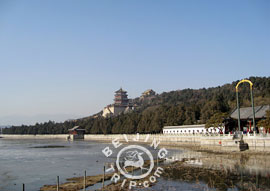 At the foot of the front hill, an ancient-style archway provides the main entrance for climbing the hill. On the way up, visitors may see the major structures neatly ordered along a north-south ascending axis: Gate of Dispelling Clouds (Paiyunmen), Second Palace Gate (Ergongmen), Hall of Dispelling Clouds (Paiyundian), Hall of Moral Glory (Dehuidian), Tower of Buddhist Incense (Foxiangge) and the Hall of the Sea of Wisdom on top of the hill. The most noteworthy structure of the back of the Longevity Hill is a building complex in Tibetan lamasery style. It is considered to be a miniature Potala Palace, the most famous resort of Lhasa in Tibet.
Long Corridor
The Long Corridor (Changlang), 728 meters (796 yards) in length, is the longest of its kind not only in China but also in the world. In 1992, it was put into the Guinness World Record as the longest corridor of the world. Running from the Yaoyuemen (Gate of Inviting the Moon) in the east to the Shizhang Pavilion in the west, the corridor includes 273 sections, all decorated with paintings. Along the corridor, four elegant octagonal pavilions are interspersed in order, each of which symbolizes one season of a year.
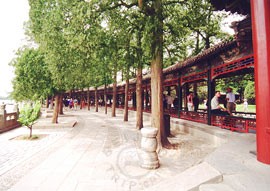
The corridor is also an exceptional art gallery, featuring more than 14,000 pictures of landscapes, flowers, birds, human figures and stories on its beams and ceilings. It is an excellent carrier of the Chinese culture, including traditional art, history and literature. Of special note are the pictures of human figures depicting stories that give a lively account of long history of China. As there isn't additional explanation in the pictures, visitors have to imagine what the picture is about from people's expression, costumes, acts and the narrative scenes.
The corridor wanders westward from the Court Area, along the north bank of the Kunming Lake, at the foot of the Longevity Hill. It is virtually a smart connecter of the three scenic areas in the Summer Palace, which make it a primary route for visiting the whole garden, rain or shine.
Go to the Next Attractions: Hall of Dispelling Clouds, Tower of Buddhist Incense & Hall of the Sea of Wisdom

